Circularity is security.
It is not just an environmental topic but also a strategic, geopolitical and economic necessity for Europe. And the Circular Economy Act and Single Market are key levers to drive progress towards securing Europe’s strategic autonomy.
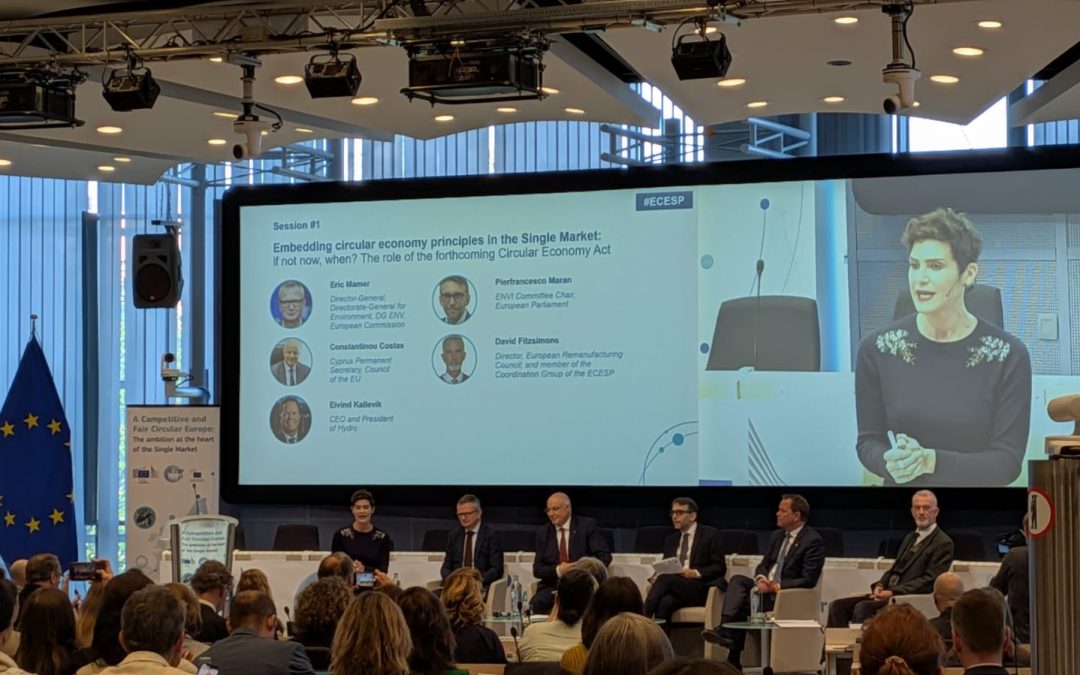
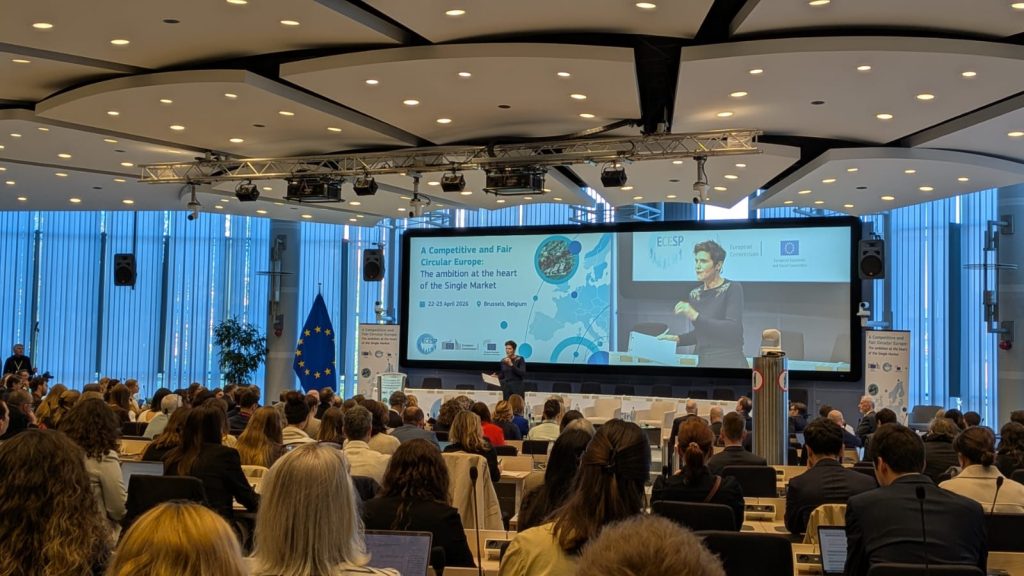
The annual European Circular Stakeholder Platform (ECESP) conference in Brussels (April 22-23) placed the Circular Economy Act (CEA) and the Single Market at the heart of the agenda. The message from the conference was unequivocally clear: security is linked with circularity and that decreasing dependence on critical raw materials from non-EU countries will strengthen European strategic autonomy and geopolitical resilience. Material sovereignty is everything and Europe’s waste is it most strategic asset.
To ensure Europe moves in this direction, trust between partners is key to drive enforcement, emphasised Valere Moutarlier, Deputy Director-General for European Industry and Decarbonisation (DG GROW).
“We need strong partners aligned on the objectives… you don’t do great things if you’re not strong, so we’re working on strong regulatory and operational setups. If we are trusted partners, then we need to be committed to enforce what we decide mutually.”
Moutarlier also said that there are some evolutions on this front, especially when it comes to the Critical Raw Materials Act (CRMA) and strategic projects, some with third countries.
“We will continue to be the regulator of the European Union. We will push for the Circular Economy Act (CEA) but we’re equally busy with some tasks like on the CRMA and strategic projects. On this, we are promoting enhancement of the projects to deliver on the ground, for example, how do we shape the operational feasibility and bring investors to the table. We are also working on how to push for off-takes, not only mining, extraction and processing but also recycling.”
He added: “We have 25 recycling-oriented Critical Raw Material projects, some of them with third countries. So, we are going into executive types of tasks to deliver on the ground and not only to regulate from Brussels.”
His remarks are key to situate an important and strategic project such as the Horizon Europe project iBot4CRMs within the rapidly changing geopolitical context.
Our project is of strategic importance to the EU given our main objective to recover and recycle Critical Raw Materials using AI-driven robotics from urban waste and reduce dependencies on third countries to secure raw materials. By harnessing urban mining to supplement external sources, our project will strengthen Europe’s resilience and competitiveness in securing CRMs such as neodymium (for magnets), copper, gold, and silver.
While recovery and recycling are important processes to secure a sustainable supply of critical raw materials, improving the business case for recycled and secondary raw materials is equally crucial to increase acceptance and attract investments for circular products.
This is exactly what the stakeholders overwhelmingly voted for when asked by the moderator on what needs to be done to accelerate the circular economy. The most upvoted answer was “Circular Economy Act must address and “improve the business case for recycling and secondary raw materials.”
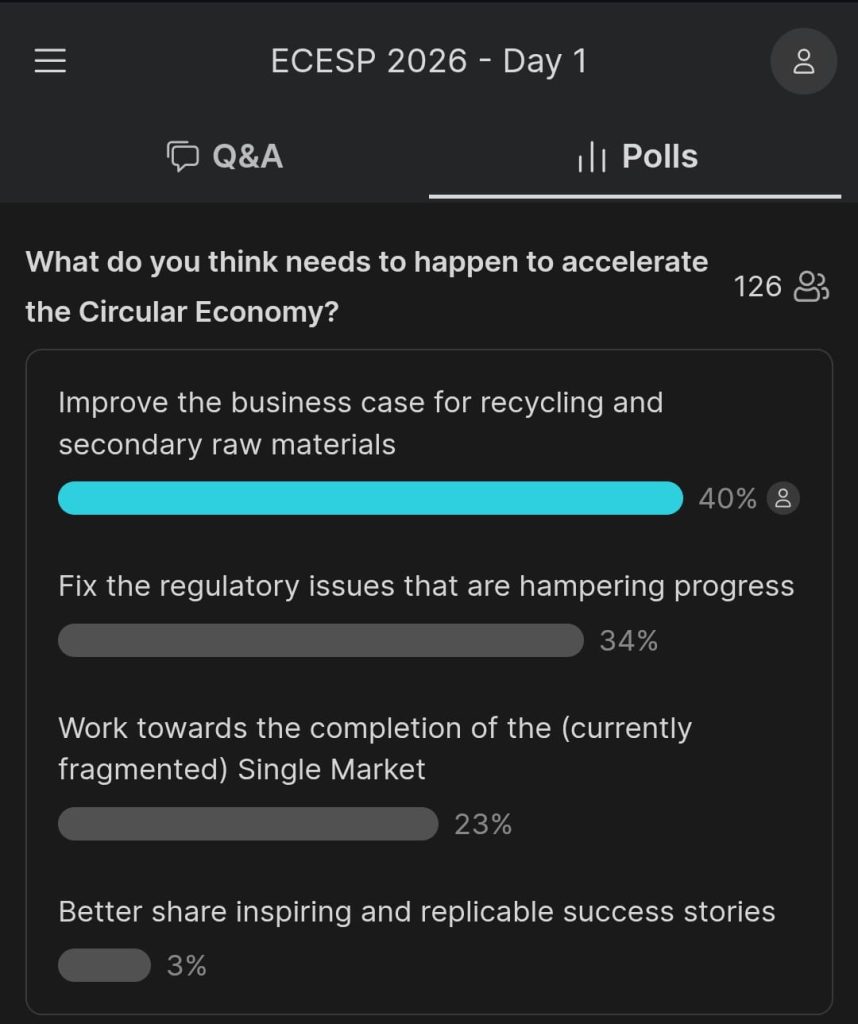
This is one of the main concerns that is potentially disallowing uptake and circularity of secondary raw materials in Europe.
Fixing regulatory issues that hamper progress was the second most voted answer.
It is clear what the stakeholders want reflected in the Circular Economy Act.
But what are some areas of intervention to ensure the Circular Economy Act reflects the real issues blocking the circular flow of secondary raw materials?
Waste Management and harmonisation of standards are key to CE to scale secondary raw material flows, says Eric Mamer, DG Environment, European Commission. “How do you ensure that waste is no longer considered waste but secondary raw materials? In Circular Economy, we are thinking about how to ensure we move very seriously to define what is waste and what is secondary raw materials not in one member state but across the EU.”
Mamer highlighted that harmonisation is the missing layer, and that different member states have different rules and this creates a natural barrier for the flow of secondary raw materials across the EU.
“When you talk of circulation of waste and it is not described as secondary raw materials. But then you have other types of waste that are hazardous and where conditions are stricter and you have to get authorisation etc. So, there are lot of things that are inhibiting the flow of what should be the feedstock for the recycling industry,” he added.
Another big roadblock to accelerate a circular economy is the massive financing gap of 82 billion Euros per year needed to decarbonise the economy, highlighted Emmanuel Chapponiere from the European Investment Bank (EIB). Circularity is very much competing on an uneven playing field.
For Andrei Geica, Chief Policy and Impact Officer at Sporos Platform, the financing gap in circularity initiatives exists because financial sector still favours a linear model. He offered three insights from a private capital perspective that explain the gap.
Firstly, capital behaves exactly like water — it flows naturally. Financial gravity is still overwhelmingly in favour of the linear model, and that is why the financing gap exists; Secondly, there is plenty of capital available, but not for circularity; and lastly, companies and SMEs are not always rational actors — they are resistant to change and prone to short-termism.
For Chaponniere, the main issue is not a lack of capital availability but the conditions under which it moves. “I don’t think capital availability is the issue but bankability of operations.” The question came back to the feedstock issue. “You need to create the market and ensure there is enough feedstock and demand for that, he emphasised.
Ultimately, for a circular economy, we need the three ingredients: A market for circular products, enough feedstock, and demand for these products. This will also ensure security and sustainability on economic, geopolitical, social and environmental fronts.